
Let us give thanks to God;
his love is everlasting!
Glory to the Father, and the Son, and to the Holy Spirit, as it was in the beginning, is now, and will be for ever. Amen. Alleluia!



|
Add this to your site |
Recent Posts


| ||
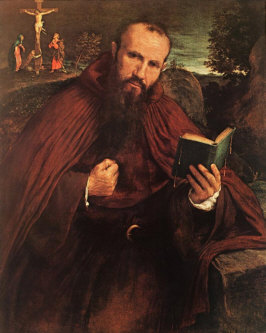
It is unfortunate that no contemporary biography was written of a man who has exercised measureless influence on monasticism in the West. Benedict is well recognized in the later Dialogues of St. Gregory, but these are sketches to illustrate miraculous elements of his career. Benedict was born of a distinguished family in central Italy, studied at Rome and early in life was drawn to the monastic life. At first he became a hermit, leaving a depressing world—pagan armies on the march, the Church torn by schism, people suffering from war, morality at a low ebb. He soon realized that he could not live a hidden life in a small town any better than in a large city, so he withdrew to a cave high in the mountains for three years. Some monks chose him as their leader for a while, but found his strictness not to their taste. Still, the shift from hermit to community life had begun for him. He had an idea of gathering various families of monks into one “Grand Monastery” to give them the benefit of unity, fraternity, permanent worship in one house. Finally he began to build what was to become one of the most famous monasteries in the world—Monte Cassino, commanding three narrow valleys running toward the mountain. The Rule that gradually developed prescribed a life of liturgical prayer, study, manual labor and living together in community under a common father (abbot). Benedictine asceticism is known for its moderation, and Benedictine charity has always shown concern for the people in the surrounding countryside. In the course of the Middle Ages, all monasticism in the West was gradually brought under the Rule of St. Benedict. Today the Benedictine family is represented by two branches: the Benedictine Federation and the Cistercians. Comment:
Quote:
| ||
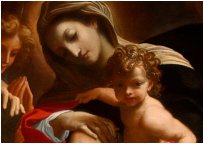
Visitation of Our Lady (1 B.C.)The Visitation of Our Lady (1 B.C.) to the house of Elizabeth and Zachary, the mother and father of Saint John the Baptist. As soon
as Mary, the spouse of Saint Joseph, had learned from an angel that, as she had conceived a Child virginally, so Elizabeth, her cousin, had conceived one miraculously, she made haste to
go and visit Elizabeth. Mary arrived at the house of Elizabeth at Ain Karim, a little town southwest of Jerusalem, on April 2. She stayed there for three months. Elizabeth greeted Mary
with the phrase, "Blessed art thou among women, and blessed is the fruit of thy womb." It was standing in the door of Elizabeth's house that Our Lady sang her great canticle, the Magnificat.
Mary waited for the birth of John the Baptist on June 24, and left for Nazareth on July 2, the day after Saint John the Baptist was circumcised and given his name. This day, the day of Mary's
leaving Elizabeth, is celebrated as the feast of the Visitation.
Mary's visit to Elizabeth was the greatest visit paid by anyone to anyone in the history of the world. All Catholics call it, in simple reference, the Visitation. The moment Mary, with Jesus in
her womb, entered the house of Elizabeth, on April 2, John the Baptist was sanctified in his mother's womb. He received at that moment the use of reason, and for three months antecedent
to his birth, he knew, in humility and love, Who was dwelling in his house. He also knew his own purpose as the Precursor of Christ.
John the Baptist was born six month before Jesus. John the Baptist was martyred one year before Jesus. The day Jesus was born, the days begin to increase. The day John the Baptist was born, they begin to decrease. "He must increase and I must decrease," is the beautiful way this seasonal fact is referred to in liturgical love in Holy Scripture by Saint John the Baptist.
Saint Processus and Saint Martinian (67)
These were the guards of Saints Peter and Paul when they were kept in the Mamertime Prison in Rome. Along with forty-seven prisoners they were converted by Saint Peter. Since there was no
water with which to baptize them, Saint Peter by his prayer caused to gush forth a miraculous spring which continues to flow to the present day. This lets us know that God will never fail to
provide the water necessary for the sacrament of Baptism without which no one can enter Heaven. Saints Processus and Martinian were cruelly tortured and finally beheaded.

picture was brought from the Island of Crete and was taken to Rome. It was placed in the Church of Saint Matthew, in Rome. There, for three hundred years, pilgrims came to reverence
and pray before this holy picture, because everyone loved its simplicity, its beauty and its truth. After the French Revolution, when the vicious Napoleon desecrated thirty Catholic Churches in
Rome, this precious picture of Our Lady of Perpetual Help was hidden away, but it was rediscovered in 1862. It was then placed in the Church of Saint Alphonsus Maria de Liguori,
founder of the Redemptorist Order, in Rome, where it is now kept. The purpose of this lovely picture is by way of simple and innocent symbol to teach us that Our Lady is our help in all
things, and our help at all times. Many Catholic churches in all countries are called by the name, Our Lady of Perpetual Help.
Feast of the Visitation of the Blessed Virgin Mary  May 31
|


When Jesus saw his mother,
and the disciple whom he loved standing near,
he said to his mother, "Woman, behold, your son!"
Then he said to the disciple, "Behold, your mother!"
And from that hour the disciple took her to his own home.Gospel of John 19:26-27
The Necessity of an Ordered Prayer Life for Every Catholic Soul In this treacherous and Godless world we live in, we may well wonder how it is possible to maintain a prayer life and to seek to live in unity with Christ, while corruption and immorality run rampant in all corners. We see pictures and hear stories of long ago when priests were recognizable in their cassocks, nuns in full habit were aiding souls in hospitals and schools, confession lines were long and satisfied by the presence of good, holy priests thirsting to bring countless souls to God.
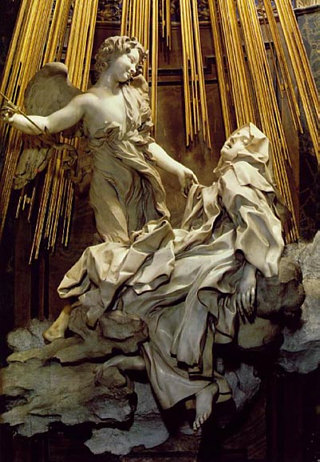
The Ecstasy of St. Teresa
(St. Teresa's Feast Day was October 15th) "Prayer…is so useful and necessary that without it we could not come to any good,
seeing that by means of prayer we are shown how to perform all our actions well."
(St. Francis de Sales, Doctor of the Church)
It seems now, though, that we are left alone to work out our salvation in fear and trembling. We can search far and wide for spiritual direction, yet scarcely find one priest who still holds the true Faith. Rather, the world is saturated with liberalism and modernism. The only thing that seems to be intolerable in this world is traditional Catholicism. It seems, also, that we are left to books and a sort of “do it yourself” program to developing a prayer life.
Be of good cheer, though, my friends! Did not our precious Lord and Savior Himself promise that He would be with us until the end of the world? Our faith will be tried and tested over and over again, but we must always remember that Our Lord, Jesus Christ is always with us. The more we are able to empty ourselves of the world and its vanities and false securities, the more room we have leave in our souls to be occupied by this Divine Guest. We must equip ourselves, then, for combat. This we are able to do by prayer. As Our Lord bade Peter, James and John in the Garden of Gethsemane, we must watch and pray, lest we become prey to the enemy.
Though prayer can sometimes be difficult and extremely trying, truly nothing is simpler than prayer itself. God, who is all knowing, is well aware of the struggles a soul undergoes in striving towards union with Him. He knows the soul’s disposition, and He knows the frailty of human nature. He does not require that our prayer be perfect and that we never have distractions; rather, it is our will that He asks be turned over to Him, and this is where a true life of prayer begins. “The principal petition which we ought to make to God is that of union of our wills with His, and the final cause of prayer lies in desiring only God. Union with God consists in conforming our will to His.” (St. Francis de Sales)
St. Francis de Sales tells us that there are three things necessary to praying well: to be little by humility, to have great hope, and to be conformed to Jesus Christ crucified. First, in order to pray well, we must acknowledge that we are very poor, and we must humble ourselves greatly, becoming fully aware of our nothingness. David admonishes us that the lower we plunge ourselves into the contemplation of our nothingness, the more easily will our prayer rise up to heaven. (Cf. Ps. 130:1-2, Sir. 35:21)
Hope is also a necessary condition to praying well. Hope is pleasant, since it promises that we shall one day possess what we long for. It is also bitter, because we are not now enjoying what we love. It is necessary, then, that hope be placed upon charity, lest it become no longer hope but, rather, presumption. If we want our prayer to reach heaven, it must be founded upon love.
Finally, in order to pray well, we must conform ourselves to Christ crucified. While hanging from the Cross, our Savior offered His prayers to the Father for us. We must, then, remain at the foot of the Cross and never depart from there, so that we may be saturated with the Blood which flows from it. We should, at the very minimum, be bathed in this Blood at our first prayer in the morning, placing ourselves at the foot of the Cross and offering our every thought, word, and action to our crucified Savior. We must ask Him to aid us in keeping before our minds the awareness of His Passion, and that we carry our Cross each day next to Him, that we may be conformed to His likeness.
Having satisfied these necessary conditions, there are three types of prayer which St. Francis de Sales teaches: vital prayer, vocal prayer, and mental prayer. Each and every action performed by those who live in the holy fear of God is a continual prayer. This is called vital prayer. Vital prayer comes simply in the form of performing the daily duties of our state in life for the greater honor and glory of God. He is pleased to accept them all, even our shortcomings and infirmities. We need only offer them up to Him when first we wake in the morning, and then throughout the day. Those who perform the corporal works of mercy such as visiting the sick, giving to the poor, and praying for the conversion of sinners and the souls in purgatory, are praying, and these actions do not go unnoticed by our Heavenly Father. Vocal prayer is, simply put, speaking to God. We ought to have a daily routine of vocal prayer consisting of, at minimum, morning prayers and evening prayers said kneeling before the Crucifix. Ought we not on bended knee to make Our Lord the object of both our first and our last thoughts of the day? In the morning, we should offer all we are to do and to endure in the day to Him. Likewise, at night, we ought to thank Him for the graces given to us throughout the day, recite the Confiteor for our failings, and ask His refuge and protection through the night. Each day, as we begin anew in His service, we must remember to ask for the graces never to offend him and to accept whatever crosses may be sent our way. Our Lord’s first thoughts in the stable at Bethlehem were of His love for mankind whom He desired to redeem, and His final thoughts on Calvary were also of His great love for us. His life was a continual offering of Love for us. Should we not offer love for Love?
St. Frances De Sales Teaches there are Three Types of Prayer:
1. Vital Prayer 2. Vocal Prayer 3. Mental Prayer
We can also approach our Lord through mental prayer. Although sometimes difficult and filled with distractions, we are all quite capable of it. Once we have offered our distractions to God and have resolved to persevere through even the worst of distractions, we can be assured that our prayers will be accepted by Him with even more value than if they had come quite easily with no distractions at all!
St. Ignatius of Loyola has provided a great method of meditation that even beginners may successfully implement into their spiritual lives. We need only take a mystery, for example Our Lord’s Agony. Having pictured Our Lord thus, we then consider His virtues such as His total resignation to the will of God, His concern for His Holy Mother and for His Apostles, His gentleness, His humility, His patience, etc. Having considered all of this, it should follow that our sentiments are moved to a desire to imitate Him and to ask our Heavenly Father to conform us to His likeness. This same exercise can be performed with a spiritual book, a holy picture, or any other means which may serve to keep the desired image in our mind.
Finally, when we find ourselves unsuccessful in vocal or mental prayer, or the duties of our state in life limit our time for prayer, we can proceed to another type of mental prayer, which is made by way of ejaculations. There is not a person in the world who can be excused from this, as it can be made simultaneously with performing any of our daily duties, regardless of time and place. All we must do is recommend ourselves to God the first thing in the morning, tell Him that we desire never to offend Him, and then go about our daily duties resolved to continuously raise our spirits to God mentally, even amidst others. No one or nothing can prevent us from making these simple aspirations within our hearts, with the exception of ourselves. Finally, it is important to note that all of this is of little use if we are not trying to live virtuous lives and to avoid the occasions of sin. We must do more than simply pray for those virtues necessary to our salvation. If we are to expect God to provide us with graces we ask and need, we must do our own part. If we have bad companions, we must rid ourselves of them. While it is true that we must love the sinner and hate the sin, St. Teresa of Avila admonishes us that there are few things more dangerous to a soul than bad companions. It is quite presumptuous and tempting God to remain in the company of these companions, thinking that we are strong enough to avoid falling into sin. We must, rather, surround ourselves with virtuous friends and companions. No friends at all are better than sinful ones.
Mental Prayer
Television and music are great weapons of the enemy, as they are vehicles for the spread of impurity and immorality. Moreover, noise is a great distraction and obstacle to prayer and contemplation. We cannot possibly reach a state of contemplation, nor can we meditate with their noise and distractions. Many will say that they are not tempted by the content from television and radio. How presumptuous this is! It is this very presumption that often causes man to fall. We must keep in mind that Our Lord is with us, and we subject Him to the very things that we watch and listen to! We would do well to rid ourselves completely of these temptations. However, for those who cannot do without them, great caution should be exercised in their use.
We must also continuously struggle against our passions and vices through prayer and mortification. This must not be put off until tomorrow, as we know not the day or the hour when we will be called to judgment. Each day, we must equip ourselves to do combat against ourselves and against the enemy. We must not cease to fight until our pilgrimage in this life is over. Since it is true that the devil preys easily on the passions of those who are idle, we should develop an horarium that will fit with our state in life, and we should hold ourselves accountable for adhering to it as best we can. Remember well that we will be required to make an account for every second of our life when we are called to judgment.
Finally, and extremely crucial to the spiritual life, is a strong devotion to the Blessed Mother of God. She is the mediatrix of all graces, a fountain of mercy, and our greatest Advocate before Our Lord, Jesus Christ. Those who have remained close to Our Lady, dating back to the Apostles, have persevered in faith. In the end times, it will be She Who will lead Christ’s army to wage battle against the enemy. We should consecrate ourselves to Her and willingly become Her slaves. She has asked that we recite the Rosary daily and has made great promises to those who do so faithfully. How simple it is to do this very little that She requests! Likewise, there are great promises attached to the five First Saturdays of Our Lady, and this is a great weapon for the spiritual life!
In this treacherous world we live in, the enemy has but one mission and that is the damnation of souls. It seems, when we look around, that there is little hope. However, we need only look at the Crucifix to see that there is great hope for those who love and fear God. We need only to persevere in faith and to carry our Cross next to that of Christ. Our greatest weapon in this battle is prayer. We must never cease to pray, and we must continually place all of our hope and trust in God, that we may one day be united to Him for all eternity.